The first community-powered detector

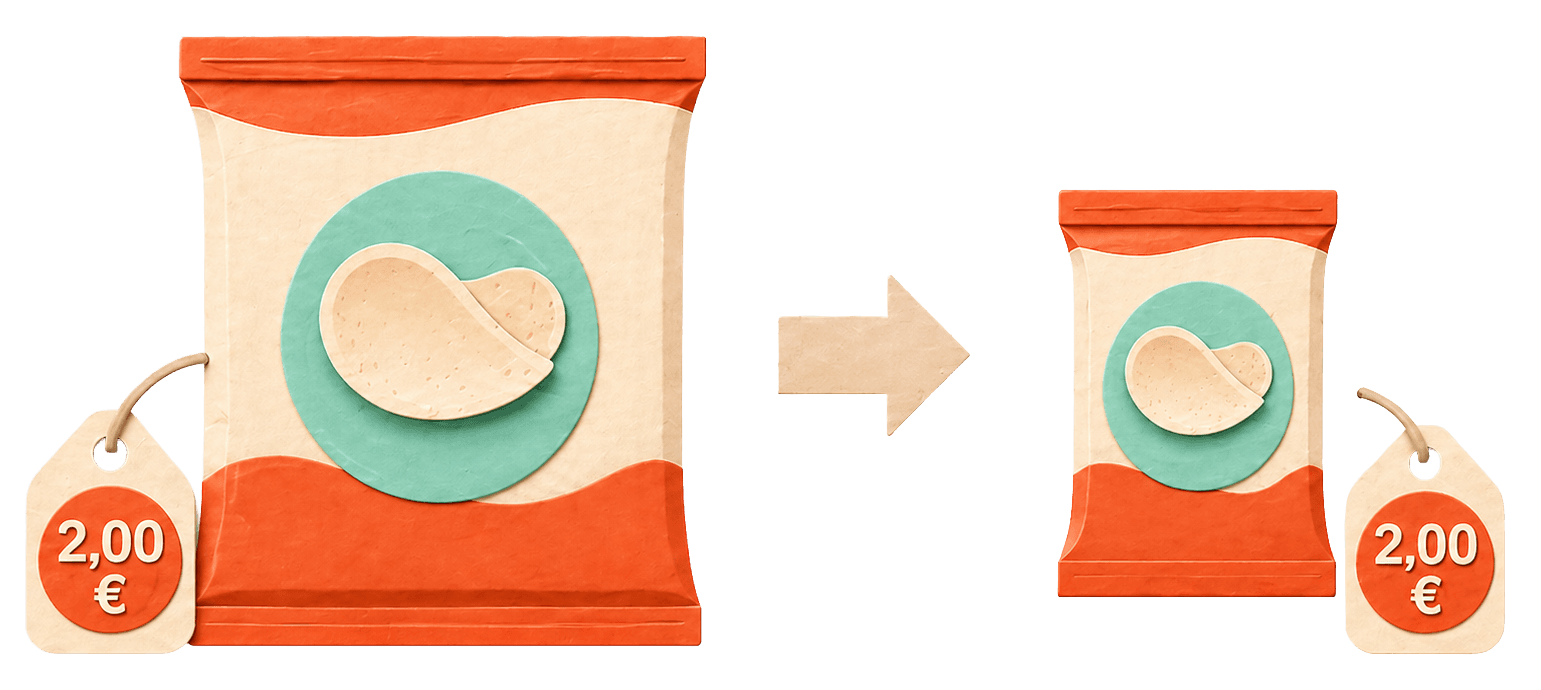
200 g yesterday, 150 g today, same price

Shrinkflation is a price rise that never announces itself: the quantity drops, the price tag does not move. Per kilo, you pay more. Here is how it works, what the law requires, and what Aukilo keeps visible over time.

A 200 g bag of chips becomes a 150 g bag, the price stays at €2
1

A price rise you cannot see

Cutting the quantity sold while keeping the displayed price raises the price per kilo without touching the number you read on the shelf. The pack often keeps its size, its colour and its place in the aisle. Only the weight, printed small, changes.

2

What the law covers, and what it leaves out

In France, since 1 July 2024, shops larger than 400 m² must flag a drop in quantity at an unchanged price, with a notice next to the product. The obligation lasts only two months, spares smaller shops, and ignores stretchflation, where the pack grows but costs more per kilo.

3

What Aukilo measures continuously

Every price entry records the weight alongside the price. When a product changes format, the gap shows up in its history and the product is flagged, well beyond the two months of mandatory display. That memory is built by contributors, shop after shop.

Frequently asked questions

Is shrinkflation illegal?
No. A manufacturer may change the quantity it sells. What is regulated is consumer information: in France, since July 2024, a drop in quantity at an unchanged price must be flagged on the shelf for two months, in shops larger than 400 m².
How can I spot a smaller pack myself?
By reading the price per kilo rather than the price tag: it is the only measure that cancels out the format. You also need the product history, because a weight on its own tells you nothing. What reveals the drop is the way it changes.
How is this different from stretchflation?
Shrinkflation cuts the quantity at a constant price. Stretchflation does the opposite: the pack grows, the price grows more, and the price per kilo rises despite the appearance of a better deal.
Read the price per kilo, not the tag

Aukilo compares the price per kilo, per litre and per unit across thousands of products, format by format and retailer by retailer.